




December 3, 2025 at 6.00pm – 7.30pm
Online
Challenging Governance Through Punishment and the Politics of Solidarity
For more than two decades, the movement to end mass incarceration has sought to challenge policing, criminalization and incarceration as harmful institutions. Amongst the harms perpetrated by these carceral systems is the punishment paradigm, a term that signifies the hegemonic power of punishment as it now exists in the U.S., embedded in culture, media, law, and policy. Despite a heightened consciousness around the negative impacts of punitive systems following the uprisings of 2020, the institutions of punishment have remained largely intact.
The Trump administration has significantly escalated the use of punishing institutions, like policing, detention, incarceration and deportation, to target migrants, dissidents, and all people at the margins. The federal government has also increased its use of punishment practices, like the threats to punish institutions for not complying with government demands, the outsourcing of punishment to everyday people, and the impunity offered for otherwise punishable offenses to those who side with the administration. This escalation has demonstrated the centrality of punishment to authoritarian regimes, and laid bare the devastating consequences for our communities.
This panel conversation will analyze the role of punishment in our current political moment, and explore why and how our movements must confront the punishment paradigm as part of a necessary strategy to build sufficient power to achieve both ideological and material wins. The panel will also explore the politics of solidarity (in contrast to capitulation) to discuss why and how solidarity is vital to survival and power-building.
***Register through Ticket Tailor to receive a link to the live-streamed video on the day of the event. This event will also be recorded and captioning will be provided.***
Speakers:
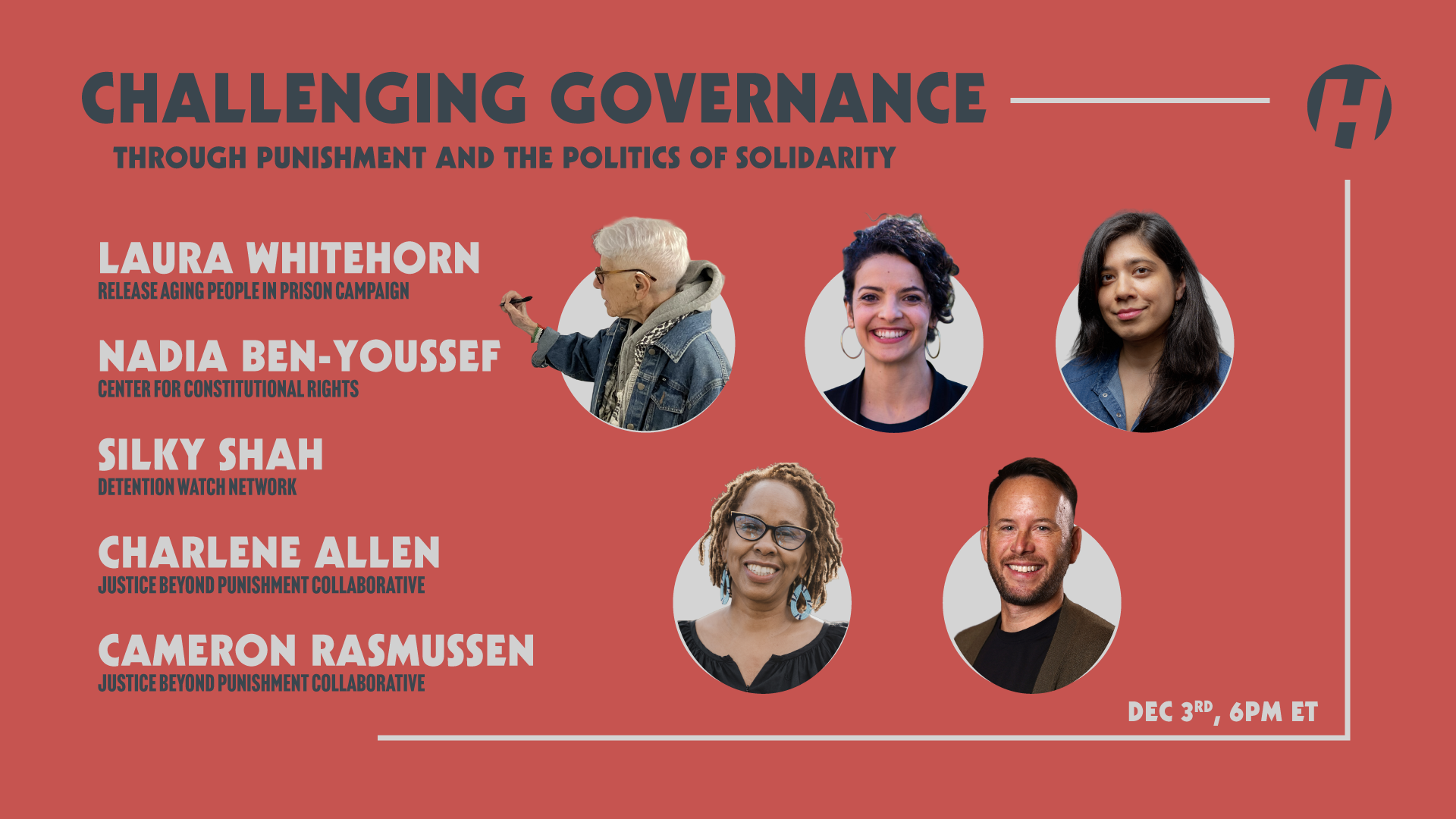
Laura Whitehorn served 14+ years in federal prison for the “Resistance Conspiracy” case.” Released in 1999, she works in the Release Aging People in Prison Campaign (RAPPCampaign.com), and for the release of political prisoners. She edited the "The War Before" by late Black Panther political prisoner and organizer, Safiya Bukari (feministpress.org) and helped organized the 2014 Interference Archive exhibition "Self Determination Inside/Out" which showed how the struggles of incarcerated people affected and shaped social movements on the outside (https://interferencearchive.org/program_title/self-determination-inside-out/). With her partner, the writer Susie Day, she was part of the prison, labor, and academic delegation to Palestine in 2016.
Nadia Ben-Youssef (she/her) is the granddaughter of artists, refugees, and revolutionaries. A human rights lawyer by training, Nadia currently serves as the Advocacy Director at the Center for Constitutional Rights, a legal and advocacy organization working with social movements and communities under threat to dismantle racism, cisheteropatriarchy, economic oppression and abusive state practices. She has expertise in international human rights fora and mechanisms, and extensive experience developing advocacy strategies to influence U.S. decision-makers. Her work often centers at the intersection of art and advocacy, and she curates exhibits and artistic programming that document key human rights concerns, celebrate social movements, and allow creatives the space to chart the future. Central to Nadia's lifework is a commitment to the liberation of Palestine, and she is a proud co-founder of the Adalah Justice Project. Nadia is a member of the NY State bar, and serves on the Boards of Adalah Justice Project, the Institute for Justice and Democracy in Haiti, and Multitude Films. Together with her family, Nadia is currently documenting the life and vision of her grandfather Salah Ben Youssef, a Third World revolutionary and freedom fighter of Tunisia’s independence movement who was assassinated in 1961.
Silky Shah is the executive director of Detention Watch Network, a national coalition building power to abolish immigration detention in the US. She is also the author of the recently published book, Unbuild Walls: Why Immigrant Justice Needs Abolition (Haymarket, 2024). Originally from Texas, she began fighting the expansion of immigrant jails on the US-Mexico border in the aftermath of 9/11 and has worked as an organizer on issues related to immigration detention, the prison industrial complex, and racial and migrant justice for over two decades. Her writing on immigration policy and organizing has been published in Teen Vogue, The Nation, Truthout, Inquest, and The Forge and in the edited volumes, The Jail is Everywhere (Verso, 2024), Resisting Borders and Technologies of Violence (Haymarket Books, 2024), and Transformative Planning (Black Rose Books, 2020). She has also appeared in numerous national and local media outlets including The Washington Post, NPR, and MSNBC.
Charlene Allen is a writer and activist who works with community organizations to heal trauma and foster justice. She has been a restorative and healing justice practitioner for over a decade and advocates for policy changes to expand the use of community-based restorative practices. With Purvi Shah, she co-facilitates the NYC Collaborative for Restoring Healing and Transforming Communities, which addresses intimate partner violence through community-specific restorative and healing approaches. As a writer, Charlene’s debut novel, Play the Game, (HarperCollins, 2023), explores and advances restorative and healing justice practices in real life situations
Cameron W. Rasmussen is a social worker, researcher, educator, and facilitator. He is an assistant professor at the Thompson School of Social Work & Public Health at the University of Hawai’i at Mānoa where he researches issues of accountability, violence, and justice, and the intersections of abolition and social work. Cameron is a Co-Editor of Abolition and Social Work: Possibilities, Paradoxes and the Practice of Community Care and is a Collaborator with the Network to Advance Abolition in Social Work (NAASW).
Co-Sponsors: Justice Beyond Punishment Collaborative, Center for Justice at Columbia University, Center for Constitutional Rights, and Haymarket Books.