November 17, 2026 at 5.00pm – 6.30pm
Online
RegisterIn the wake of hurricanes, earthquakes, and fiscal collapse, Puerto Ricans have confronted the limits of state-led reconstruction and the rise of disaster capitalism. At the same time, they have forged new community-based experiments in self-governance, collective care, and imaginative practice.
Post-Disaster Futures brings together scholars, artists, and activists. Moving between the archipelago and its diaspora, the volume traces a collective effort to rethink what repair means when the very institutions of recovery and governance perpetuate the damage they claim to fix. Through essays, interviews, poetry, and conversations, the contributors explore themes ranging from energy justice and housing displacement to memory, migration, and artistic practice. Collectively, they show how the ruins of colonial modernity can be sources of solidarity and imagination.
***Register through Ticket Tailor to receive a link to the live-streamed video on the day of the event. This event will also be recorded and captioning will be provided.***
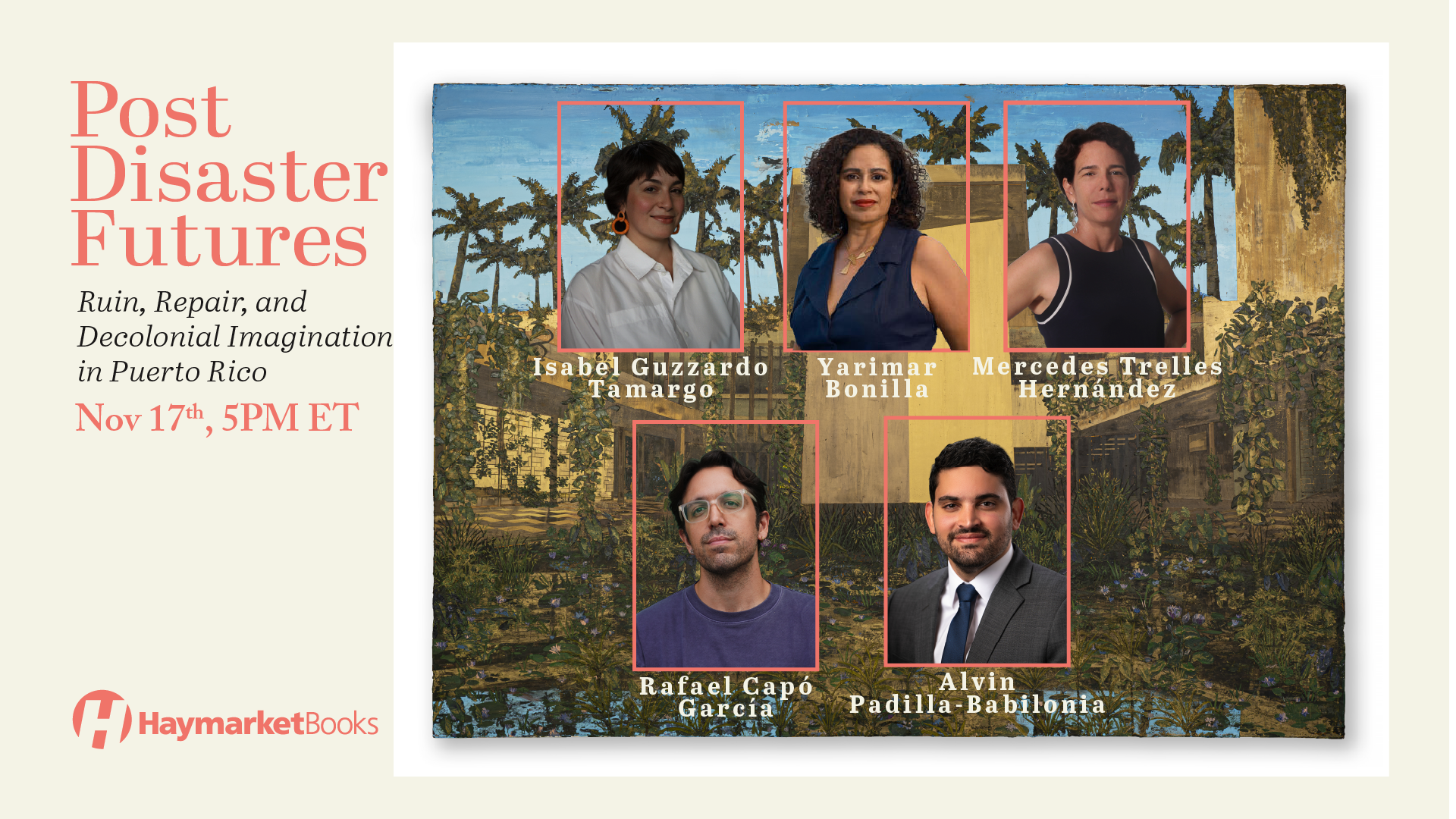
Speakers:
Yarimar Bonilla is a professor at Princeton University’s Effron Center for the Study of America, an award-winning filmmaker, and a contributing writer for New York Times Opinion. She is the author and editor of multiple books, including Non-Sovereign Futures: French Caribbean Politics in the Wake of Disenchantment and Aftershocks of Disaster: Puerto Rico Before and After the Storm. She has written and produced several award-winning documentaries, including Privatized Resilience, and is cofounder of the public humanities project Puerto Rico Syllabus. She previously served as director of the Center for Puerto Rican Studies at Hunter College.
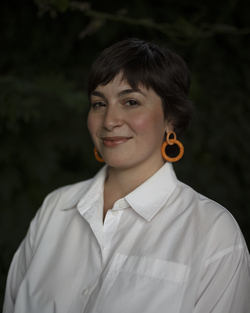
Isabel Guzzardo Tamargo is an Assistant Professor of Literatures of the Americas in the English Department at Seton Hall University. She has published peer-reviewed articles, book chapters, and reviews, exploring the Black radical tradition and issues of gender and sovereignty in Jamaican, Puerto Rican, and Dominican literature. She is a principal collaborator of the Puerto Rico Syllabus, a digital project that provides materials to understand Puerto Rico’s debt crisis.
Alvin Padilla-Babilonia is an Associate Professor of Law at Villanova University School of Law. His scholarship focuses on the constitutional legacy of American colonialism and the relationship between law, race, and empire. He is interested in exploring what we can learn about constitutionalism through the history of colonialism, as well as how constitutionalism constrains democracy and decolonization. Padilla-Babilonia’s scholarship has appeared or is forthcoming in the Minnesota Law Review, Fordham Law Review, Michigan Law Review, Duke Law Journal, and University of Puerto Rico Law Review, among others.
Before joining Villanova Law, Padilla-Babilonia taught at the University of Puerto Rico School of Law. In 2022, he was selected as a Bridging the Divides fellow for the decolonization study group funded by the Mellon Foundation and convened by the Center for Puerto Rican Studies. He earned a JSD and an LLM from Yale Law School, as well as a JD and a BA from the University of Puerto Rico.
Mercedes Trelles Hernández is Director of the Art History Program at the University of Puerto Rico, Río Piedras Campus. She holds a Ph.D. from the Department of the History of Art and Architecture at Harvard University and works as an independent curator. Her recent curatorial projects include Rastros: Eduardo Lalo, Edna Román, and John Rivera Pico at the Museo de la Universidad Ana G. Méndez; Provocations: Unreleased Works from the Colección Chocolate Cortés at Fundación Cortés in Old San Juan; and Among Ruins: Recent Art from Puerto Rico at the Museo de Arte y Diseño de Miramar. She also co-curated Redux: Héctor Méndez Caratini’s Five-Decade Journey for the Museo de las Américas, Old San Juan. Trelles Hernández is an art critic for Revista Plástica and has contributed to numerous academic publications. Her recent work includes the essay “Against the Heroes: Revolution, Repression, and Raúl Martínez’s Cuban Pop Art” in Pop Art and Beyond: Gender, Race, and Class in the Global Sixties (2022), a collaboration with A–Z of Caribbean Art (2019), and “Pop Art in Argentina” in The World Goes Pop (2015). She is currently writing an essay on queer sexuality in 1960s Caribbean art for the Handbook of Gender and the 1960s, and curating an upcoming exhibition on the relationship between Puerto Rican and North American art.
Rafael Capó García is the founder and director of Memoria (De)colonial, a nonprofit organization that critically examines the legacies of colonialism in Puerto Rico and the Caribbean through experimental, community-engaged public humanities initiatives. He is an adjunct professor at the University of Puerto Rico, where he teaches Caribbean critical theory and public history. He holds an MA in History and a PhD in Curriculum Studies from the University of British Columbia. Before entering academia, he spent six years teaching Social Studies in public schools in his hometown of Cangrejos, Puerto Rico, where he still resides. His research interests include Caribbean philosophy, decolonization, public memory and commemorative landscapes, the histories of slavery and marronage, and critical tourism.
--------------------------------------------------------------
This event is sponsored by Haymarket Books. While all of our events are freely available, we ask that those who are able make a solidarity donation in support of our important publishing and programming work.
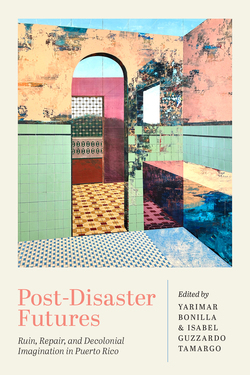
Edited by Yarimar Bonilla and Isabel Guzzardo Tamargo

Edited by Yarimar Bonilla and Marisol LeBrón
Edited by Yarimar Bonilla and Marisol LeBrón
In 2026, we’re celebrating 25 years of publishing “Books for Changing the World.” In those 25 years, we’ve helped build critical space and infrastructure for radical ideas and movements on the left to grow. That work of institution-building and popular political education has never been more necessary or more urgent. We need your help to continue to do this work.